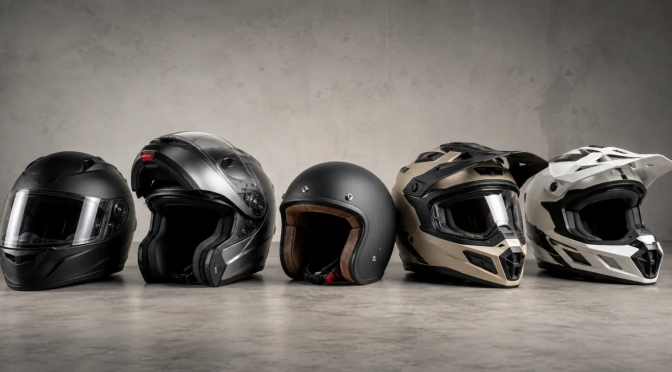
A motorcycle helmet is a rider’s primary defense against head injuries in a crash. Its protective structure manages impact energy, covers vulnerable areas of the head, and helps keep the helmet securely in place. Designs differ considerably in coverage, construction, ventilation, and fit. An open-face model may feel cooler in city traffic, but it leaves the chin and jaw exposed. A full-face helmet provides more extensive coverage, with some compromises in airflow and convenience.
Choosing the right helmet involves more than comparing prices or shell materials. Motorcycle helmet safety depends on certified performance, proper fit, reliable retention, and appropriate coverage. A premium racing model that creates painful pressure points or moves excessively on the head is not a suitable choice.
This guide examines motorcycle helmet types, safety standards, protective materials, and fitting methods. It also covers the features that matter most to sportbike riders, including aerodynamics, visibility, and ventilation.
Why Motorcycle Helmet Design Matters for Rider Safety
A helmet manages impact energy through several components. The outer shell distributes loads, resists penetration, and may deform under force. Beneath it, the energy-absorbing liner compresses to reduce peak head acceleration. Comfort padding maintains the helmet’s position, while the retention system helps prevent it from coming off during a crash.
Each component serves a different purpose. A rigid shell without an effective impact liner cannot provide adequate protection, and thick comfort padding cannot compensate for an incorrectly sized helmet.
Coverage matters as well. Full-face helmets provide structural coverage around the chin and jaw. Open-face designs leave these areas exposed, even when equipped with a visor. Modular helmets incorporate a movable chin bar, with protection depending on its design, certification, and locked position.
No helmet prevents every injury. Crash angle, impact surface, speed, and rotational movement influence the forces reaching the head. Even properly fitted, certified equipment cannot eliminate the risk of concussion or severe head trauma.
Main Types of Motorcycle Helmets
Helmet designs reflect different riding priorities. Some emphasize comprehensive coverage and high-speed stability, while others favor airflow, convenience, or compatibility with off-road equipment.
Full-Face and Racing Helmets
A full face motorcycle helmet encloses the head and incorporates a fixed chin bar. It covers the forehead, temples, back of the skull, and lower face. A movable shield protects the eyes from wind and debris, while ventilation openings help regulate airflow.
Full-face designs are widely used for commuting, touring, and sport riding. Their enclosed construction generally provides better weather protection than open-face alternatives, although wind noise varies with visor sealing, shell geometry, and motorcycle aerodynamics.
A racing motorcycle helmet is a specialized full-face design developed for sustained high-speed riding. Typical features include:
- Aerodynamic shells and spoilers intended to reduce drag and buffeting.
- Eye ports positioned for visibility in a racing crouch.
- Secure visor locking mechanisms.
- Ventilation channels optimized for airflow at speed.
- Firm cheek pads that help maintain stability during rapid movement.
Some models also feature emergency-release cheek pads, allowing trained responders to remove interior padding before carefully removing the helmet.
Track-focused designs are not necessarily ideal for commuting. Large vents can increase noise, and an eye port optimized for a tucked position may restrict visibility when sitting upright.
Modular and Open-Face Helmets
A modular motorcycle helmet has a chin bar that pivots upward, allowing riders to expose their faces without removing the helmet. This convenience appeals to commuters and touring riders, although hinges and locking mechanisms add complexity.
Not every modular helmet is approved for riding with its chin bar raised. Under ECE regulations, P/J homologation identifies models approved for use in both their designated closed and open configurations. Riders must still follow the manufacturer’s operating instructions.
An open face motorcycle helmet, commonly called a three-quarter helmet, covers much of the skull but leaves the lower face exposed. Its open front improves airflow and makes communication easier at stops.
A face shield can block insects, rain, and airborne debris, but it cannot replace a structural chin bar during an impact. Three-quarter helmets also differ from half helmets, which cover a smaller portion of the head.
Off-Road and Adventure Helmets
Off-road helmets are developed for motocross, enduro, and trail riding. Their characteristic features include an extended chin bar, a large eye opening, and a projecting peak.
The wide eye port accommodates motocross goggles. The peak helps shield the eyes from sunlight and deflect some mud and debris, while generous ventilation supports physically demanding riding.
Dedicated motocross helmets generally lack a conventional road-style face shield. Riders instead use compatible goggles with lenses suited to the conditions.
Adventure helmets combine off-road and street features. Many include a clear face shield, removable peak, and space for goggles, making them practical for mixed-surface travel.
At highway speeds, the peak can increase aerodynamic drag and wind noise, particularly behind a turbulent windscreen. Removing it, where permitted by the design, may improve comfort.
Competition eligibility depends on more than helmet category. Racing organizations and track operators may require specific certifications.
Understanding Motorcycle Helmet Safety Standards
Motorcycle helmet safety ratings are often compared as though they form a single ranking. In practice, certification systems use different impact conditions, testing methods, and acceptance limits.
Motorcycle helmet certification establishes compliance with a defined standard, not guaranteed protection in every crash scenario.
ECE 22.06
ECE 22.06 is the current major United Nations motorcycle helmet approval regulation used across many international markets. It superseded ECE 22.05 for new type approvals and introduced additional impact tests.
The regulation evaluates helmets at multiple locations and under different conditions. Alongside conventional linear impact measurements, it includes oblique impact testing that assesses rotational motion.
An ECE 22.06 helmet must also satisfy applicable requirements covering retention systems, visors, and other construction features. Approved accessories and configurations may require additional testing.
The approval label, generally attached to the chin strap, identifies the approval authority and certification details.
The introduction of ECE 22.06 does not automatically prohibit continued use of older ECE 22.05 helmets. Rules concerning sale and use depend on the jurisdiction.
DOT and Snell Certifications
In the United States, motorcycle helmets manufactured for on-road use and offered for sale must comply with Federal Motor Vehicle Safety Standard No. 218, commonly called DOT FMVSS 218.
The standard establishes requirements for impact attenuation, penetration resistance, retention systems, and peripheral vision.
A DOT motorcycle helmet carries a manufacturer’s certification of compliance. The National Highway Traffic Safety Administration conducts compliance testing and enforcement, but it does not individually approve every helmet before sale.
Snell helmet certification follows a different approach. The Snell Memorial Foundation operates voluntary testing programs with requirements that vary by certification standard and helmet category. These may include impact, penetration, and other performance evaluations.
A helmet can meet multiple standards. Buyers should verify the exact certification designation and confirm that it applies to the model being purchased.
Helmet Construction and Protective Materials
Motorcycle helmet materials influence weight, manufacturing methods, and structural behavior, but protective performance depends on the complete design.
Common shell materials include polycarbonate and other thermoplastics, fiberglass composites, carbon-fiber composites, and combinations of reinforcing fibers.
Thermoplastic shells are economical to manufacture and can provide effective impact resistance. Composite construction allows manufacturers to adjust fiber orientation, reinforcement, and shell stiffness.
Carbon fiber offers a high stiffness-to-weight ratio, making relatively lightweight shells possible. However, a carbon-fiber helmet is not automatically safer than a well-engineered fiberglass or polycarbonate model.
Most conventional helmets contain an expanded polystyrene (EPS) impact liner. During a significant impact, this material compresses and deforms, dissipating energy and reducing peak acceleration transmitted to the head. The deformation is largely irreversible, and internal damage may not be visible externally.
Some helmets use multiple EPS densities or additional systems intended to manage rotational forces. Their effectiveness depends on the engineering and testing of the complete helmet.
The comfort liner maintains contact with the head and helps manage moisture. Removable cheek pads and interior padding also simplify cleaning and, where supported, fitting adjustments.
Retention systems commonly use double D-ring fasteners or purpose-designed quick-release buckles. Both require correct fastening and adjustment.
How to Choose the Correct Helmet Size and Fit
Motorcycle helmet fit depends on head circumference and shape. Two riders with identical measurements may require different models because their head profiles differ.
Measuring Head Circumference
Wrap a flexible measuring tape around the widest part of your head, just above the eyebrows and ears. Keep it level around the back and record the measurement in centimeters.
Compare the result with the manufacturer’s motorcycle helmet size chart. Letter sizes are not standardized across brands, and different models may use different internal shapes.
Head profiles are commonly described as round oval, intermediate oval, or long oval, referring to their relative width and front-to-back length.
A correctly fitted helmet should feel evenly snug around the crown, with firm cheek-pad contact. It should not create painful pressure points, numbness, or persistent discomfort.
Wear it for 15 to 30 minutes during a fitting session. Concentrated forehead or temple pressure often indicates an unsuitable internal shape rather than a need for a larger size.
With the chin strap fastened, gently move the helmet from side to side. It should move with your head rather than sliding independently. Check that it resists being rolled off without applying excessive force.
Riders who wear prescription glasses should test their usual frames inside the helmet. The temples must fit comfortably without disturbing the glasses’ position.
Comfort padding may settle with use, but the EPS impact liner does not break in the same way. Buying an oversized helmet in anticipation of future comfort compromises fit from the beginning.
Features That Matter for Sportbike Riding
Sportbike ergonomics place particular demands on helmet design. Riders lean forward and tilt their heads upward to see the road, making eye-port placement and aerodynamic stability especially important.
Aerodynamics and Ventilation
At highway speeds, airflow creates drag, lift, turbulence, and noise around the helmet. Shell geometry and spoilers are designed to manage these effects as riders move between upright and tucked positions.
Performance also depends on the motorcycle. Windscreen height, rider proportions, and seating position influence the airflow reaching the helmet.
Motorcycle helmet ventilation typically uses front intake openings and rear exhaust ports. Air passes through internal channels, carrying heat and moisture away from the head.
Cooling effectiveness changes with speed. Large vents may perform well on the highway but provide limited relief in slow traffic. Opening them can also increase noise.
Ventilation does not replace hearing protection. Prolonged exposure to wind noise can damage hearing even inside a full-face helmet. Properly fitted earplugs help reduce exposure.
Visibility, Visors and Noise Reduction
Sportbike riders should assess visibility while seated in their normal riding position. The upper edge of the eye port must not obstruct the road when leaning forward.
Visor quality matters. Scratches, optical distortion, and reflections can interfere with judging distances and identifying hazards.
Many helmets support Pinlock-style anti-fog inserts, which create an insulating air gap against the inner shield surface. Other designs use anti-fog coatings or directed airflow.
Tinted visors reduce glare but may be unsuitable or unlawful at night. Light-transmission requirements vary by jurisdiction.
Helmet noise depends on visor seals, neck openings, ventilation ports, and airflow around the motorcycle. A snug neck roll may improve comfort, but it cannot guarantee safe noise exposure during long rides.
Common Mistakes When Choosing a Motorcycle Helmet
A certified helmet can still be unsuitable if its fit or design does not match the rider’s needs. Common mistakes include:
- Choosing appearance over fit: Graphics and brand reputation cannot compensate for an unsuitable internal shape.
- Buying a helmet too large: Excessive movement can compromise stability and retention.
- Treating certifications as interchangeable: DOT, ECE, and Snell use different testing procedures.
- Prioritizing minimum weight: Comfort also depends on balance, aerodynamics, and riding duration.
- Buying an unknown used helmet: Previous impacts and liner damage may leave no visible evidence.
- Modifying protective components: Drilling the shell, cutting EPS foam, or applying incompatible adhesives can compromise protection.
Price is not a direct measure of crash performance. Premium helmets may offer lighter construction, better ventilation, and more refined visor mechanisms, but a less expensive certified model with excellent fit can be the better purchase.
When shopping online, use reputable sellers and verify certification markings, model details, and return policies. Counterfeit or incorrectly labeled products can be difficult to identify from photographs.
Helmet Care, Inspection and Replacement
Regular motorcycle helmet care helps preserve the shell, visor, interior, and retention components.
Clean the exterior with mild soap, water, and a soft cloth, following the manufacturer’s instructions. Avoid harsh solvents and incompatible adhesives that could damage protective materials.
Wash removable liners and cheek pads as recommended, allowing them to dry completely away from direct heat.
Inspect the shell for cracks, the visor mechanism for damage, and the chin strap for fraying or faulty operation. Check that the interior continues to hold the helmet securely.
Motorcycle helmet replacement is necessary when a crash or substantial impact may have compromised its protective structure. Internal damage cannot always be detected visually, so follow the manufacturer’s guidance rather than relying on exterior appearance.
Many manufacturers recommend replacement after approximately five years of regular use. Some also specify a maximum period from manufacture. These recommendations vary by model and should not be treated as a universal expiration date.
Heavy use, perspiration, ultraviolet exposure, and improper storage can accelerate deterioration. Store helmets in a cool, dry location away from chemicals and direct sunlight.
FAQ
Which type of motorcycle helmet offers the most coverage?
A full-face helmet provides the most comprehensive conventional coverage, including a fixed chin bar around the lower face. Actual protection still depends on construction, certification, fit, and impact conditions.
Is ECE 22.06 better than DOT certification?
ECE 22.06 includes oblique impact testing not required under DOT FMVSS 218. DOT remains the applicable federal standard for motorcycle helmets sold for road use in the United States. Neither certification alone establishes a universal ranking of individual models.
How tight should a motorcycle helmet fit?
It should feel firmly snug without causing pain or numbness. The cheek pads should maintain contact, and the helmet should move with the rider’s head rather than sliding independently.
How often should a motorcycle helmet be replaced?
Follow the manufacturer’s recommended service life, often around five years of regular use. Replace it sooner if an impact may have damaged its protective structure or if the shell, retention system, or fit has deteriorated.
Are modular helmets suitable for sportbike riding?
Modular helmets can suit sportbike riding when correctly certified and fitted. Check chin-bar approval, forward visibility in a leaned-over position, and aerodynamic stability. Track-day organizers may impose additional restrictions.
The right motorcycle helmet depends on head shape, riding conditions, and intended use. Full-face designs offer extensive coverage, modular helmets add convenience, and off-road models accommodate goggles and demanding terrain.
For sportbike riders, forward visibility and stability in a tucked position deserve particular attention. Before buying, verify the certification, test the fit in a realistic riding posture, and make sure the helmet remains securely in place without creating painful pressure points.