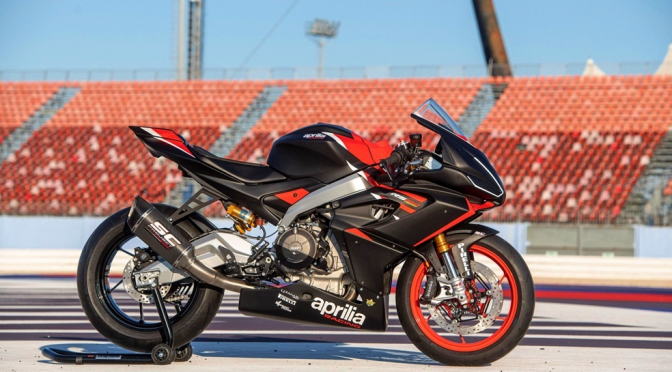
The Aprilia RS 660 occupies a distinctive place in the middleweight sportbike market. Its aluminum chassis, aerodynamic fairing, and advanced electronics draw on Aprilia’s racing experience, while the parallel-twin engine and relatively moderate ergonomics make it practical beyond the racetrack. Instead of pursuing maximum horsepower, the RS 660 emphasizes responsive handling, accessible acceleration, and precise control.
The 2025 update introduced a stronger engine, revised aerodynamics, and additional electronic assistance. Output increased to 105 hp, throttle-body diameter grew to 52 mm, and integrated winglets became part of the redesigned fairing. These changes strengthened an already capable platform without altering its fundamental character.
Understanding the Aprilia RS 660 specs requires looking beyond peak power. Chassis geometry, suspension adjustment, braking equipment, and electronic calibration all influence how the motorcycle behaves on winding roads and technical circuits.
The Aprilia RS 660 and Its Place Among Italian Sportbikes
Aprilia established its reputation through Grand Prix racing and World Superbike competition. The RS 660 draws on that experience without adopting the extreme performance priorities of the RSV4 superbike.
Traditional supersport motorcycles often combine high-revving engines with aggressive riding positions and chassis settings developed primarily for circuit use. The RS 660 follows a different formula. Its 659 cc parallel twin delivers useful midrange torque, while the compact aluminum frame provides the stiffness needed for accurate steering.
The engine forms part of the load-bearing chassis, reducing the need for additional structural material. Combined with relatively compact dimensions, this arrangement helps keep weight manageable and contributes to the motorcycle’s responsive handling.
Among Italian sportbikes, the RS 660 stands out for combining sophisticated rider assistance with accessible performance. Its competitors include the Yamaha YZF-R7 and Honda CBR650R, although differences in engine configuration, chassis construction, and equipment produce distinct riding experiences.
Engine Specifications and Power Delivery
The Aprilia RS 660 engine is a liquid-cooled parallel twin with double overhead camshafts, four valves per cylinder, and a 270-degree crankshaft. Its oversquare dimensions support higher engine speeds, while the uneven firing intervals give it a character reminiscent of certain V-twin engines.
For 2025, Aprilia increased maximum output from 100 to 105 hp and peak torque from 67 to 70 Nm. Larger throttle bodies and revised engine calibration accompanied the transition to Euro 5+ emissions compliance.
The following figures describe the updated full-power standard RS 660 introduced for 2025.
| Specification | Aprilia RS 660 |
| Engine | Liquid-cooled parallel twin, DOHC |
| Displacement | 659 cc |
| Valves | 8, four per cylinder |
| Bore × stroke | 81 × 63.93 mm |
| Maximum horsepower | 105 hp at 10,400 rpm |
| Peak torque | 70 Nm (51.6 lb-ft) at 8,400 rpm |
| Fuel delivery | Electronic fuel injection, 52 mm throttle bodies |
| Throttle control | Ride-by-Wire |
| Transmission | 6-speed manual |
| Clutch | Wet multiplate with slipper function |
| Frame | Aluminum twin-spar |
| Listed wet weight | 183 kg (403 lb) |
| Wheelbase | 1,370 mm (53.9 in) |
| Seat height | 820 mm (32.3 in) |
| Fuel capacity | 15 liters (4.0 US gal) |
The published Aprilia RS 660 weight should be interpreted according to the manufacturer’s measurement conditions. The 183 kg figure is commonly specified with operating fluids and approximately 90% of the fuel capacity rather than a completely full tank. Regional specifications and equipment can also affect the listed weight.
Earlier RS 660 models have different engine ratings, while restricted versions are available in certain markets.
Parallel-Twin Engine and Horsepower
The RS 660’s 270-degree crankshaft produces uneven firing intervals, giving the parallel twin a distinctive exhaust note and delivery reminiscent of a V-twin. The configuration provides that character within a compact engine layout.
With an 81 mm bore and 63.93 mm stroke, the engine has oversquare dimensions. The relatively large bore provides room for four-valve cylinder heads, while the shorter stroke helps limit average piston speed at higher rpm.
The 2025 revision increased throttle-body diameter from 48 to 52 mm. Alongside updated calibration, the change supports improved airflow and higher peak output while meeting Euro 5+ requirements.
The Aprilia RS 660 horsepower rating refers to output measured at the crankshaft. Rear-wheel dynamometer readings will generally be lower because of mechanical losses through the transmission and final drive.
The engine’s midrange response also distinguishes it from traditional high-revving four-cylinder supersport designs. Riders can accelerate effectively between corners without relying on a narrow band near the rev limiter.
Acceleration and Top Speed
With 105 hp and relatively low mass, the RS 660 delivers strong acceleration for its displacement class. The six-speed transmission helps keep the engine within its effective operating range, while electronic throttle mapping changes how directly it responds to rider input.
Several factors influence the Aprilia RS 660 performance:
- Standing starts: Launch Control, where equipped, helps manage engine delivery during aggressive starts. Available grip and rider technique remain important.
- Corner exits: Midrange torque provides useful drive as the motorcycle straightens and the rider progressively opens the throttle.
- Overtaking: Selecting an appropriate gear allows the engine to respond quickly without an extended buildup of rpm.
- High-speed acceleration: Aerodynamic drag becomes increasingly influential as speed rises, making body position and conditions more significant.
Aprilia has quoted a maximum speed of approximately 149 mph for an updated RS 660 Factory configuration. That figure should not be treated as a verified maximum for every standard RS 660, since gearing, equipment, aerodynamic conditions, and test procedures can differ.
For circuit riding, acceleration between corners and the ability to maintain momentum through technical sections often matter more than absolute maximum speed. The Aprilia RS 660 top speed is impressive for a middleweight twin, but its handling is central to the riding experience.
Chassis, Suspension and Braking Performance
The RS 660 uses an aluminum twin-spar frame with the engine incorporated into its load-bearing structure. This arrangement provides structural support around the steering head and engine mounts while keeping the chassis compact.
Its 1,370 mm wheelbase contributes to responsive steering and quick directional changes. Wheelbase alone does not determine handling, however. Steering geometry, weight distribution, suspension setup, and tire characteristics also influence how readily the motorcycle turns.
The standard Aprilia RS 660 suspension includes a 41 mm Kayaba inverted front fork and a rear monoshock. Both provide spring-preload and rebound-damping adjustment, allowing riders to adapt the setup to their weight and riding conditions. The available adjustment range is narrower than on the RS 660 Factory, which uses Öhlins components with more extensive tuning options.
The Aprilia RS 660 brakes feature dual 320 mm front discs with Brembo radial-mount four-piston calipers. A 220 mm rear disc provides additional braking control. This combination offers substantial stopping capability, supported by the motorcycle’s electronic ABS system.
Standard tire dimensions are 120/70 ZR17 at the front and 180/55 ZR17 at the rear. Tire compound, pressure, and temperature strongly influence braking performance and cornering grip.
For frequent track riding, suspension setup, brake-pad selection, and suitable tires may offer more practical benefits than changes to engine output.
Racing Technology and Electronic Rider Aids
The Aprilia RS 660 electronics package is unusually comprehensive for a middleweight sportbike. Its APRC system works with a six-axis inertial measurement unit that monitors acceleration and rotational movement along three axes.
This information allows several assistance systems to account for motorcycle attitude rather than relying exclusively on wheel-speed and throttle data.
The main electronic functions include:
- Aprilia Traction Control (ATC): Regulates engine torque when excessive rear-wheel slip is detected.
- Aprilia Wheelie Control (AWC): Helps manage front-wheel lift during acceleration.
- Aprilia Engine Brake (AEB): Adjusts engine-braking characteristics when the throttle closes.
- Aprilia Engine Map (AEM): Changes the relationship between throttle input and engine response.
- Aprilia Quick Shift (AQS): Supports clutchless upshifts and downshifts under suitable conditions.
- Aprilia Cruise Control (ACC): Maintains a selected cruising speed.
- Aprilia Launch Control (ALC): Helps manage engine delivery during standing starts on equipped versions.
These systems operate through an integrated electronic architecture. Traction control, for example, can use inertial data to refine intervention according to the motorcycle’s lean and movement.
The updated RS 660 also incorporates aerodynamic winglets into its fairing. Their effects become more relevant at higher speeds, when aerodynamic forces increase substantially. The design aims to improve stability without requiring the large external aerodynamic elements seen on some racing motorcycles.
Riding Modes and Traction Control
Five Aprilia RS 660 riding modes provide different combinations of engine mapping and electronic assistance. Three are intended for road use, while two prioritize circuit riding.
| Riding mode | Intended use |
| Commute | Everyday riding with progressive throttle response |
| Dynamic | Sport-oriented road riding |
| Individual | Customizable road settings |
| Challenge | Performance-focused track riding |
| Time Attack | Customizable track settings |
Commute prioritizes progressive throttle behavior and assistance suited to ordinary road conditions. Dynamic provides a more direct response for spirited riding, while Individual allows riders to personalize available settings.
Challenge and Time Attack are intended for circuit use. Time Attack offers greater flexibility when configuring electronic intervention for particular riding preferences and track conditions.
Traction control regulates excessive rear-wheel slip by modifying engine output. It does not create additional grip. Tire temperature, road contamination, lean angle, and throttle application still determine the available traction.
Quickshifter, ABS and Electronic Settings
The bidirectional quickshifter allows gear changes without conventional clutch operation when engine speed and operating conditions are suitable.
During upshifts, the system briefly reduces engine torque to unload the transmission. On downshifts, electronic throttle management helps synchronize engine speed with the lower gear.
This reduces interruptions during acceleration and simplifies gear selection when approaching corners. At very low speeds or outside the system’s operating range, conventional clutch use remains appropriate.
The RS 660 also features multimap Cornering ABS. Conventional ABS monitors wheel-speed behavior to detect impending lockup. Cornering ABS additionally uses inertial information to account for motorcycle attitude and lean angle.
Three ABS maps offer different intervention characteristics. Less intrusive settings may be useful in appropriate riding conditions, but they cannot increase the friction available between the tires and road surface.
A five-inch color TFT display presents motorcycle information through road- and track-oriented layouts. Riders can view essential operating data and electronic settings, while additional performance-recording capabilities depend on the motorcycle’s equipment and accessories.
Aprilia RS 660 Handling on Road and Track
The RS 660 changes direction quickly, helped by its compact aluminum chassis, relatively short wheelbase, and sport-oriented geometry. Its steering response is particularly noticeable through sequences of tight corners.
The riding position places the rider farther forward than on most naked motorcycles, improving the connection with the front end without demanding an extreme racing crouch.
On winding roads, the chassis supports accurate line selection and progressive changes in lean angle. Smooth throttle application and consistent braking technique help maintain stability through linked corners.
Circuit riding places greater demands on suspension control, tire performance, and braking consistency. The standard motorcycle is capable of recreational track use, although frequent sessions may justify changes to suspension settings, brake pads, and tire selection.
The Aprilia RS 660’s track performance benefits from its manageable power delivery. Compared with a liter-class superbike, the motorcycle places fewer demands on throttle control, allowing riders to concentrate on corner-entry speed, body positioning, and maintaining momentum.
Its accessible character does not eliminate the need for skill. Abrupt braking, steering, or throttle inputs can still exceed the available grip.
Ergonomics and Everyday Riding Comfort
The RS 660 offers a less aggressive riding position than traditional track-focused supersport motorcycles. Its clip-on handlebars, seat placement, and footpeg position encourage a forward lean without forcing the rider into a particularly low crouch.
The 820 mm seat height will suit many riders, although shorter motorcyclists may find it difficult to place both feet securely on the ground. Seat width and individual leg length matter as much as the published height.
At highway speeds, the fairing and windscreen reduce direct wind exposure, especially when the rider leans forward. The revised bodywork also manages airflow around the motorcycle, although its effectiveness varies with riding position and speed.
Several features improve everyday usability:
- Cruise control reduces continuous throttle input during highway travel.
- The TFT instrument panel provides access to riding information and electronic settings.
- A 15-liter fuel tank offers practical capacity for regular road use.
- Adjustable riding modes allow throttle response and assistance settings to suit different conditions.
There are compromises. The forward-leaning posture can become uncomfortable during extended periods in traffic, passenger accommodations are limited, and the suspension retains a firm sporting character.
Riders who regularly cover long distances may prefer a motorcycle with upright handlebars, greater wind protection, and more relaxed passenger accommodations.
How the RS 660 Compares With Other Middleweight Sportbikes
Middleweight sportbikes differ considerably in engine layout, chassis construction, and electronic equipment. Comparing displacement or horsepower alone provides an incomplete picture of their capabilities.
The Yamaha YZF-R7 uses a 689 cc parallel-twin engine and emphasizes responsive handling and accessible torque. Its design is comparatively straightforward, although electronic equipment varies by model year. The Aprilia places greater emphasis on integrated rider-assistance technology. Honda’s CBR650R uses an inline-four engine with a smoother, higher-revving character. Its additional cylinders and different chassis arrangement create a distinct riding experience, particularly in engine response and overall feel. The Kawasaki Ninja ZX-6R follows a more traditional supersport formula. Its high-revving four-cylinder engine and track-oriented design prioritize performance at higher engine speeds, making it a different proposition from the RS 660.
Few middleweight sportbikes combine a compact parallel twin, an aluminum frame, and such an extensive electronics package. The RS 660’s advantage lies in how these elements work together rather than in any single specification.
Strengths, Limitations and Ideal Riders
An Aprilia RS 660 review should consider its technical strengths alongside the practical compromises involved in owning a premium European sportbike.
Its principal advantages include responsive steering, strong braking equipment, adjustable electronic assistance, and an engine suited to both road riding and circuit use.
The standard suspension offers useful adjustment for everyday riding and occasional track sessions. Riders seeking greater control over compression and rebound damping may prefer the Factory version, whose Öhlins components provide more extensive setup options.
Ownership costs also deserve attention. Performance tires, scheduled servicing, insurance, and replacement components can make the RS 660 more expensive to maintain than simpler middleweight motorcycles. Actual expenses depend on mileage, riding style, service requirements, and regional parts availability.
The motorcycle is particularly suitable for experienced riders moving up from smaller sportbikes, motorcyclists seeking a lighter alternative to a superbike, and enthusiasts who combine regular road use with occasional track days.
Beginners should approach the full-power model cautiously. Although electronic assistance helps manage performance, 105 hp still provides substantial acceleration. Training, experience, and compliance with local licensing requirements remain essential.
FAQ
How much horsepower does the Aprilia RS 660 have?
The updated full-power Aprilia RS 660 produces 105 hp at 10,400 rpm. Earlier versions were rated at 100 hp, while restricted variants are available in certain markets.
What is the top speed of the Aprilia RS 660?
Maximum speed depends on model configuration, gearing, rider position, and test conditions. Aprilia has quoted approximately 149 mph for an updated RS 660 Factory configuration, but this should not be treated as a verified figure for every standard RS 660.
Is the Aprilia RS 660 suitable for beginners?
The RS 660 can be manageable for riders with appropriate training, but its acceleration and braking performance make it a demanding first motorcycle. A smaller, lower-powered sportbike generally provides a more forgiving learning platform.
Does the Aprilia RS 660 have a quickshifter?
Yes. The RS 660 features a bidirectional electronic quickshifter that supports clutchless upshifts and downshifts when operating conditions permit.
Is the Aprilia RS 660 good for track days?
Yes. Its lightweight aluminum chassis, responsive engine, Brembo braking components, adjustable suspension, and track-oriented electronic settings make it suitable for recreational circuit riding. Frequent track use may justify changes to tires, brake pads, suspension setup, and maintenance practices.
The Aprilia RS 660 combines the precision and equipment expected from a modern sportbike with performance that remains practical outside the racetrack. Its 659 cc parallel twin, lightweight chassis, and extensive electronic controls make it particularly effective on technical roads and circuits.
For riders who prioritize responsive handling, mechanical feedback, and versatility over outright superbike horsepower, the RS 660 offers a distinctive middleweight package.